The last assessment was a good opportunity to learn more about the structure of our Media exams and check we are progressing in the right direction.
The first part of your learner response is to look carefully at your mark, grade and comments from your teacher. If anything doesn't make sense, ask your teacher - that's why we're here!
Your learner response is as follows:
Create a new blog post called 'Media Assessment 2 learner response' and complete the following tasks:
1) Type up your feedback in full (you don't need to write the mark and grade if you want to keep it confidential).
2) Read the mark scheme for this assessment carefully (this has been posted to your exam teacher's Google Classroom). Identify at least one potential point that you missed out on for each question in the assessment.
3) On a scale of 1-10 (1 = low, 10 = high), how much revision and preparation did you do for this assessment? You may also want to think here whether you had completed all the original blog tasks from last term before doing the assessment.
4) Look at your answer for Question 2. Did you manage to write about three different strategies and three different benefits? It's vital you read the question and follow it exactly.
5) Look at your answer for Question 3. Did you follow the question guidance and write about both the BBC and commercial broadcasters? What could you have added to this answer to reach a higher mark?
6) Now look over your mark, teacher comments and the mark scheme for Question 4 - the 20 mark essay question on media effects theory. Write a new paragraph for this question based on the suggested theories/answers in the mark scheme. Make sure it is an extensive, detailed paragraph focused on the question and offering examples from the wider media.
If you do not finish your learner response in the lesson your work is returned, this needs to be completed at home for homework see Show my Homework for deadline.
Capital is a state-of-the-nation drama. Applying theories such as Marxism and hegemony to Capital allows us to explore the political contexts of the text. The notes from the lesson are here: Marxism In Britain and Europe, Marxist approaches were common amongst media theorists from the late 1960s until around the early 1980s, and Marxist influences, though less dominant, remain widespread. Marxist theorists tend to emphasize the role of the mass media in maintaining the status quo, suggesting power is concentrated in the hands of a narrow elite.
Marxism v pluralism
The main non-Marxist tradition is that of liberal pluralism. Pluralists see society as consisting of competing groups and interests, none of them predominant all of the time. In contrast, Marxists view capitalist society as being one of class domination; the media are seen to promote hegemonic ideology and ensure the dominance of certain classes; ultimate control is increasingly concentrated in wealthy corporations/media conglomerates; media professionals, while enjoying the illusion of autonomy, are socialized into and internalize the norms of the dominant culture.
Gramsci: hegemony
Hegemony derives from the Greek term hēgemonia (“dominance over”). Italian philosopher and Marxist theorist Antonio Gramsci used the term hegemony to describe the dominance of one social class over others – i.e. how the ruling class or elite maintain control. This represents not only political and economic control, but also the ability of the dominant class to project its own way of seeing the world so that those who are controlled by it accept it as 'common sense' and 'natural'. Commentators stress that this involves willing and active consent. Marxism & hegemony: blog tasks Task 1: Mail Online review of Capital 1) Re-read the Mail Online review of Capital. Why does it suggest that Capital features a left-wing ideology? 2) Choose three quotes from the review that are particularly critical of Capital and paste them into your blogpost. Do you agree with the criticisms? Why? 3) What scenes or characters from Capital could be read as promoting left-wing ideology? 4) What about the other side of the argument - are there any aspects of Capital that reinforce right-wing or capitalist viewpoints? Task 2: Media Factsheet - Applying Marxism Go to our Media Factsheet archive on the Media Shared drive and open Factsheet #66: Applying Marxism. Our Media Factsheet archive is on the Media Shared drive: M:\Resources\A Level or online here (you'll need your Greenford Google login to access). Read the factsheet and answer the following questions: 1) What does Marxism suggest regarding power in society? 2) Why is The Apprentice a good example of the media reinforcing capitalist values and ideologies? 3) Come up with two examples of media texts (e.g. TV programmes, newspapers etc.) that either fetishise working class life (e.g. EastEnders presents quite a harmonious East End community which probably doesn't accurately reflect East London life) or demonise working class life or poor people (e.g. The Daily Mail and The Sun newspapers regularly demonise people living on benefits with headlines referring to 'scroungers'.) Explain what meanings these texts communicate to their audiences. 4) Look at the bullet points on page 4 of the factsheet: When making a Marxist reading of a text, look out for representations that:
show the values of the power elite as beneficial to the mass
show queries or challenges to the base as meaningless, foolish or anti-social via ‘failed revolt’
show the subdominant position of the masses as a naturalised idea
show the values of the power elite as ‘natural’ or ‘right’
show that being a member of the mass is a good thing
show the masses accepting the values of the power elite
show the values of the power elite as being ‘for the good of the masses’ (even when unpleasant)
Now try applying those bullet points to Capital. Think about the setting, characters and narrative strands - how many of the bullet points apply to Capital? Does Capital reinforce or challenge the values of capitalism? Give examples from episode 1 to support your points.
Complete for homework: due date on Satchel One.
Optional extension: Media Magazine feature on BBC drama The Casual Vacancy and ideology If you'd like to further understand Marxism, Hegemony and the media, go to our Media Magazine archive and read the feature 'The Beeb, The Mail and JKR' in MM53 (page 20). This focuses on the politics of The Casual Vacancy, another BBC three-part drama based on a book by JK Rowling. After you've read the article, think about or write answers to the questions below: 1) Why did the Daily Mail suggest The Casual Vacancy promoted a left-wing ideology? 2) How does the article suggest characters, narrative and setting are used to promote a left-wing ideology? 3) What research is quoted regarding BBC bias and what did it find? Do you think the BBC is biased? 4) Gramsci's theory of hegemony suggests people are kept under control through active consent - the control of 'common sense'. How could you apply the Daily Mail or the BBC to the idea of hegemony and dominant ideologies in the UK media?
The representation of women in advertising is a vital area of study. We need to be able to discuss how representations have changed and apply these ideas to both unseen advertisements and our CSPs.
The notes from the lesson are below. Jean Kilbourne: Killing us softly
Activist and cultural theorist Jean Kilbourne has been studying the image of women in advertising for over 40 years. Her series ‘Killing us softly’ highlighted the negative representation of women in advertising. She went on to make further documentaries studying this issue and whether it was changing over time. Liesbet van Zoonen: Feminist Media Studies
Liesbet van Zoonen was one of the first theorists to explicitly link gender, feminism and media studies. Writing since the 1990s, van Zoonen is a key figure in third wave feminism alongside theorists such as Judith Butler and she also develops Mulvey’s work on the ‘male gaze’. Looking specifically at the representation of women in advertisements in the 1970s and 80s, van Zoonen questioned how much things had really changed. For example, women in adverts may be shown to have jobs but their appearance was usually still the vital element.
Liesbet van Zoonen: third wave feminist
In the 90s, van Zoonen was interested in the pleasures female audiences took from the women’s magazines that were heavily criticised by more radical 1970s-style feminists. In a similarity with Butler, van Zoonen sees gender as negotiated and dependent on social and historical context. She suggested that the meaning of gender is a “discursive struggle and negotiation, the outcome having far-reaching socio-cultural implications.” (van Zoonen, 1994)
Liesbet van Zoonen: constructing meanings
van Zoonen also built on Stuart Hall’s reception theory with regards to how gender representations communicate their meanings to audiences. She suggested the media’s influence in constructing gender is dependent on:
Whether the institution is commercial or public
The platform (print/broadcast/digital)
Genre (e.g. drama/news/advertisement)
Target audience
How significant the media text is to that audience
Blog tasks: Representations of women in advertising The following tasks are challenging - some of the reading is university-level but this will be great preparation for the next stage in your education after leaving Greenford. Create a new blogpost called 'Representations of women in advertising' and work through the following tasks. Academic reading: A Critical Analysis of Progressive Depictions of Gender in Advertising Read these extracts from an academic essay on gender in advertising by Reena Mistry. This was originally published in full in David Gauntlett's book 'Media, Gender and Identity'. Then, answer the following questions: 1) How does Mistry suggest advertising has changed since the mid-1990s? 2) What kinds of female stereotypes were found in advertising in the 1940s and 1950s? 3) How did the increasing influence of clothes and make-up change representations of women in advertising? 4) Which theorist came up with the idea of the 'male gaze' and what does it refer to? 5) How did the representation of women change in the 1970s? 6) Why does van Zoonen suggest the 'new' representations of women in the 1970s and 1980s were only marginally different from the sexist representations of earlier years? 7) What does Barthel suggest regarding advertising and male power? 8) What does Richard Dyer suggest about the 'femme fatale' representation of women in adverts such as Christian Dior make-up? Media Magazine: Beach Bodies v Real Women (MM54) Now go to our Media Magazine archive and read the feature on Protein World's controversial 'Beach Bodies' marketing campaign in 2015. Read the feature and answer the questions below in the same blogpost as the questions above. 1) What was the Protein World 'Beach Bodies' campaign and why was it controversial? 2) What was the Dove Real Beauty campaign? 3) How has social media changed the way audiences can interact with advertising campaigns? 4) How can we apply van Zoonen's feminist theory and Stuart Hall's reception theory to these case studies? 5) Through studying the social and historical context of women in advertising, do you think representations of women in advertising have changed in the last 60 years? There is a fair amount of work here - you will be given some lesson time to do it but will need to finish for homework.
Our first television close-study product is BBC state-of-the-nation drama Capital.
We need to know everything about the programme - from textual analysis of key scenes to how it was funded, distributed and promoted on the BBC and around the world. The key notes from the lesson are here: Novel adaptation
Capital is a BBC TV drama series adapted from 2012 book by John Lanchester.
The book was set in 2007-8 either side of the financial crisis but the TV drama updates it to 2015 and changes the location slightly (Clapham to Balham).
Capital: a state-of-the-nation drama
Capital is a ‘state-of-the-nation’ drama – designed to capture the issues facing the country at the time it is written and produced.
In Capital, it focuses on the economy and the financial crash, immigration, London’s housing market and the incredible mix of people in a city of 8.5 million.
Reviews Reviews of the Capital TV series drew attention to the state-of-the-nation aspect of the drama:
Ben Lawrence in the Telegraph wrote: Capital shows “an eternal London, riven by inequality and quickened by diversity”.
Ben Dowell in the Radio Times: “It shows Londoners trying to work out very real problems… there is a fierce intelligence at work here, a script which asks some very interesting and important questions but doesn’t force the answers down your throat.”
London 2009-15
Following the global financial crash in 2007-8, London was not expected to quickly recover economically.
However, house prices soared with some properties almost doubling in price in five years. By September 2015, the average London house price was £531,000.
Traditionally working-class neighbourhoods in London suddenly had houses worth £1m+.
“One in three London residents was born abroad, and a quarter of these migrants arrived since 2006. Nearly a half of the UK’s migrants live in London.”
“London’s population is characterised by rapid flux. Area stability – the proportion of a neighbourhood’s population remaining in place over time – is far lower in London than the rest of the UK.”
“Some of the most deprived migrants in the country reside in London, and some of the most privileged too… vulnerable migrants in London include asylum-seekers with subsistence-only support.”
Capital: Case study blog tasks Work through the following tasks to build a detailed case study for Capital. This will give you plenty of background information to use in an exam question. Remember, for this CSP the question could be on any of the key concepts: language, industries, audiences or representations. Reviews and features Read the following review and feature on Capital: Guardian review by Sam Wollaston London Evening Standard: five things you need to know about Capital 1) What positive points does the review pick out about Capital? What criticisms are made - either of the TV drama or the original novel?
2) What references can you find in the reviews and feature to the idea Capital is a 'state-of-the-nation' drama? How does it capture modern-day London? Trailer analysis Watch the trailer for Capital: 1) How does the drama use camerawork to capture London life?
2) How does the trailer introduce the different narrative strands suggesting tension or enigma in the 40-second running time?
Capital in Media Magazine
Issue 83 of Media Magazine has a feature exploring Capital as a media product. Read ‘We Want What You Have’ in MM83 (p10). You'll find our Media Magazine archive here - remember you'll need your Greenford Google login to access. Answer the following questions:
1) What does the article suggest about the 'state of the nation' genre and how Capital is an example of this?
2) What does the article suggest regarding the setting of Capital?
3) What are the major themes in Capital and what does the article suggest regarding the impact of money on communities?
4) What different representations in Capital are discussed in the article?
5) What does the final section of the article suggest regarding genre and overall message of the drama?
Capital Media Factsheet
Use our Media Factsheet archive on the M: drive Media Shared (M:\Resources\A Level\Media Factsheets) or on Google Drive here (you'll need your Greenford Google login) to find Media Factsheet #194 on Capital (BBC TV Drama).
Read the whole of Factsheet and answer the following questions:
1) What does the factsheet say about the characters on the first page?
2) Focusing on the industrial contexts, how does Capital help the BBC meet its obligations as a public service broadcaster?
3) What do we learn about the ownership structure for production company Kudos?
4) How can David Hesmondhalgh's ideas in The Cultural Industries be linked to Capital and Kudos?
5) How does the factsheet suggest Capital meets the genre conventions of crime and social realism?
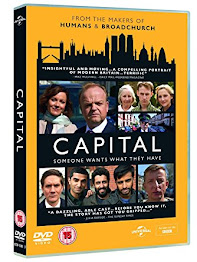
6) How does the factsheet analyse the DVD packaging and what this communicates to the audience?
7) Look at page 5 of the factsheet. Choose one of the audience theories in the table and apply it to Capital.
8) What does the factsheet suggest regarding binary oppositions in Capital?
Representations: close-textual analysis
Capital offers a range of fascinating representations - from London and asylum seekers to capitalism and inequality. You need to be able to confidently discuss these issues in the context of 2015 London - with reference to key scenes from episode 1. Representations include: London, family, gender, ethnicity, religion, immigration, asylum, inequality, wealth, capitalism, aging and more.
These are our notes from this year analysing the episode in class. There are also these notes from a previous year analysing the clips in case this is useful. Use this to help with this element of the case study. You'll need your Greenford Google login to access the document. 1) Write an analysis of the representations in each of the key scenes from episode 1 we studied in the lesson: Scene 1: opening sequence 00:30 – 4.49 Scene 2: work in the City 6.28 – 8.10 Scene 3: “Which of those isn’t absolutely essential?” 14.00 – 15.35 Scene 4: asylum 18.03 – 19.42 AND 31.10 – 32.40 Scene 5: “What use is 30 grand?” 36.40 – 39.00 Scene 6: life at the corner shop 40.10 – 42.55 You can choose which aspects to focus on for each scene: e.g. London, family, gender, ethnicity, religion, immigration, asylum, inequality, wealth, aging etc. Feel free to use bullet points for each scene - a summary of your notes is fine. 2) How does Capital use stereotypes? Do the characters and issues represented in Capital reinforce or subvert the stereotypes we typically see in the media?
Industries and production context Capital was produced by independent production company Kudos for the BBC. Look at the Kudos website and also read the Kudos Wikipedia page. 1) Who is the parent company for Kudos? What changes of ownership have there been for Kudos? This is an example of conglomerate ownership. 2) Watch the showreel on the Kudos website. What other TV dramas have Kudos produced and for which channels? What awards have they won?
Grade A/A* extension - further reading on marketing and promotion We strongly recommend you read the full BBC Press Pack for Capital. 1) How does the programme information on page 3 make Capital sound interesting to audiences? 2) Who commissioned Capital for BBC? 3) Read the interview with Toby Jones. What does he say about the character of Roger? 4) Read the interview with Adeel Akhtar (page 10). What does he suggest Capital says about the fictional Pepys Road and the sense of community (or lack of it) in London? 5) Read the interview with Shabana Azmi (page 12). What does she say about Asian representations in Britain? 6) Read the interview with Derek Wax, the Executive Producer for Kudos (page 16). Why did he produce Capital and what does it say about the way we live now?
Our new topic is Advertising and Marketing and to start with we're going to look at how producers use narrative and persuasive techniques in advertising.
For example, you will need to be able to apply the four narrative theories we have studied previously to advertising texts (possibly an unseen text). You may also need to analyse persuasive techniques in unseen texts too. Narrative theories: a reminder You can find the original lesson notes on narrative here. To summarise each theory in a word or phrase:
Todorov – Equilibrium
Propp – Familiar character types
Barthes – Enigma and action codes
Levi-Strauss – Binary opposition
Narrative in advertising: Jonah Sachs American writer Jonah Sachs has highlighted the importance of storytelling in advertising and marketing:
“The story wars are all around us. They are the struggle to be heard in a world of media noise and clamour. Today, most brand messages and mass appeals for causes are drowned out before they even reach us. But a few consistently break through the din, using the only tool that has ever moved minds and changed behaviour – great stories.”
Narrative in advertising: examples There are a huge number of examples of adverts that use narrative. This marketing blogpost highlights 12 examples (including some we looked at in the lesson). Airbnb: Breaking Down Walls
Persuasive techniques Advertisements are generally trying to persuade their target audience to:
Buy a product or service
Believe something or act in a certain way
Agree with a point of view
There are many persuasive techniques used in advertising. A selection include:
Slogan – a catchy phrase or statement
Repetition – constant reference to product name
Bandwagon – everyone is buying it
Testimonial/association – e.g. celebrity endorsement
Emotional appeal – designed to create strong feelings
Testimonial/association – Nespresso / George Clooney
Emotional appeal – WaterAid ‘Dig toilets not graves’
Expert opinion – Max Factor ‘The make-up of make-up artists’
Case study: Marmite
Marmite has a long history of unusual advertising based around the idea ‘You either love it or you hate it’. How many of the persuasive techniques can you spot in these adverts?
Introduction to advertising: blog tasks
Create a new blog post called 'Advertising: Introduction to advertising blog tasks'. Read ‘Marketing Marmite in the Postmodern age’ in MM54 (p62). You'll find our Media Magazine archive here - remember you'll need your Greenford Google login to access. You may also want to re-watch the Marmite Gene Project advert above. Answer the following questions on your blog: 1) How does the Marmite Gene Project advert use narrative? Apply some narrative theories here.
2) What persuasive techniques are used by the Marmite advert?
3) Focusing specifically on the Media Magazine article, what does John Berger suggest about advertising in ‘Ways of Seeing’? 4) What is it psychologists refer to as referencing? Which persuasive techniques could you link this idea to? 5) How has Marmite marketing used intertextuality? Which of the persuasive techniques we’ve learned can this be linked to? 6) What is the difference between popular culture and high culture? How does Marmite play on this? 7) Why does Marmite position the audience as ‘enlightened, superior, knowing insiders’? 8) What examples does the writer provide of why Marmite advertising is a good example of postmodernism?
We are now completing our mammoth MIGRAIN Introduction to Media unit. You've covered a huge amount of work since September and now have a grounding in all the key concepts of A Level Media - well done!
We now need to update our MIGRAIN blog index (we last did this at Christmas) with all the work we've done since. As you know, it is important we are revising terminology and theory on an ongoing basis and making sure there are no gaps as the course continues. The vast majority of the course will be tested in an exam situation and there could easily be a question on a specific theory or aspect of media terminology that we've covered in the last three half-terms. If you have missed any lessons or blog tasks this will significantly disadvantage you.
MIGRAIN Final index
Keeping an index of all your work is extremely good practice from a revision perspective. Not only does this keep the concepts and media terminology fresh in your mind but it will also highlight if you've missed anything. Your final index should include the following:
You'll have done some of this index already - a quick time-saving tip is to copy the HTML from your original index blogpost and paste it in your new index blogpost. This will give you most of the links and you can add to it from there. If you simply add to your previous index, make sure you change the date to today (use the 'Schedule' tab on the right-hand menu to do this). Remember, this is your index, so the text should link to your corresponding blogpost so you can access your work on each key concept quickly and easily. This also means you if you have missed anything you can now catch up with the work/notes and won't underperform in future assessments due to gaps in your knowledge.
MIGRAIN assessments
You'll have a short assessment next half-term testing the final elements of the MIGRAIN introduction to Media unit. For this week's assessment, focus mainly on the Audience and Industry key concept work in October-December. You can use this index as the basis for your revision for both assessments. Due date: on Show my Homework (including any missing work the index has highlighted)
Our TV Drama CSPs are BBC state of the nation dramaCapitaland critically acclaimed German Cold War spy thrillerDeutschland 83.
We need to make sure we are experts in television drama for this major section of Media Paper 2 - conventions, media language, notable successes and historical context. TV Drama: key notes
Television drama is a hugely popular genre and a staple across schedules and streaming services. ‘Binge-watching’ is a relatively recent phenomenon while other dramas have built hugely loyal fanbases (e.g. Doctor Who, Game of Thrones). There are many sub-genres and hybrid genres in TV drama from the costume drama to the hospital drama. Setting TV dramas tend to take place in recognisable settings with regular locations that characters can inhabit. Most dramas are defined by their location and the iconography (mise-en-scene) is vital for communicating the sub-genre and narrative expectations to the audience.
Even science-fiction family dramas such as Doctor Who feature regular settings such as the Tardis. Character Most TV dramas have a large ensemble cast – a range of characters. These characters are often stereotypical – communicating a lot to the audience quickly. Often recognisable and relatable – giving audiences the pleasure of identification and an ongoing ‘relationship’: we keep watching to find out what happens to them.
Characters often reflect the sub-genre (think police, hospital or period costume drama stock characters). Narrative
Most TV dramas have multi-strand narratives telling a range of interconnected storylines. An overall narrative arc often goes over the whole season or series. Others feature episodic narratives with storylines resolved in one episode. Flashbacks can also feature.
Many TV dramas now employ a ‘cold opening’ – the opening scene taking place before credits/titles – designed to create enigma and draw the audience in. Ultimately, it is the sub-genre of the TV drama that will help set narrative expectations for the audience.
Note: If you missed the initial lesson on TV Drama, we analysed some TV drama opening scenes to explore how the setting, character and narrative is established using technical codes (e.g. camerawork/editing/mise-en-scene) and audio codes (dialogue/voiceover/diegetic and non-diegetic sound).
Introduction to TV Drama: Blog tasks
Use our Media Factsheet archive on the M: drive Media Shared (M:\Resources\A Level\Media Factsheets) or on Google Drive here (you'll need your Greenford Google login) to find Media Factsheet #164 on Television Serial Drama.
Read the whole of Factsheet and answer the following questions to show your comprehensive knowledge of the television drama genre:
1) What is serial television drama? Write your own definition. 2) List five of the TV dramas discussed in the history of the genre on page 1 of the factsheet. How has the genre evolved over time? 3) List the sub-genres of TV drama featured in the factsheet. Come up with your own example of an existing TV drama to fit each category. 4) Why is setting so important for TV drama? 5) How do TV dramas typically use character? What audience pleasures can be linked to character in TV drama? (Hint: Uses & Gratifications theory!) 6) What is a multi-strand narrative? Give an example of a TV drama that features a multi-strand narrative.
7) What is a cold opening? 8) How can Todorov's theory of equilibrium be applied to TV drama serials? 9) What is the typical form for TV dramas and how are the programmes typically distributed to an audience? 10) How have subscription channels (such as HBO) and streaming services (such as Netflix and Amazon Prime) changed the form and content of TV dramas? 11) Choose a TV drama and do your own analysis of it using the SETTING / CHARACTERS / NARRATIVE / FORM headings as featured on page 3 of the factsheet. 12) How might the TV drama genre evolve in future? A/A* extension task: TV Drama v Film Building on question 12 above, read this fascinating extended article comparing TV drama to film. It will also help to bridge the gap between our work on the film industry and our new topic of TV drama. Where do you stand on the debate? Is TV drama the key medium of storytelling or will cinema always be king?
The media's role in setting and reinforcing the dominant values and ideologies within society is a vital aspect of A Level Media Studies.
The key notes from today's lesson on ideology and binary opposition: Ideology What is an ideology? An ideology is a world view, a system of values, attitudes and beliefs which an individual, group or society holds to be true or important; these are shared by a culture or society about how that society should function.
Dominant ideologies
Ideologies that are told to us repeatedly by important social institutions such as the government or media are called dominant ideologies.
Dominant ideologies are ideologies or beliefs that we live by in our day-to-day lives and often do not question – they have become 'natural, common sense' things to do. This effectively dissuades people from rebelling against these beliefs, and keeps a sense of stability in society.
Why is ideology important in Media Studies?
Media texts always reflect certain values or ideologies though sometimes we may not be aware of this. When studying a media text you may look for the dominant ideology present and question whose world view is represented and perhaps which groups have not been represented.
Levi-Strauss: cultural codes
Claude Levi-Strauss (1908-2009) was a French philosopher and one of the most important cultural theorists of the 20th century.
He viewed culture as a system of codes through which we exchange messages. These cultural codes tend to reflect the dominant values and ideologies in society.
Binary opposition
Levi-Strauss's theory of binary opposition is important for media students.
Levi-Strauss suggested everyone thinks of the world around them in terms of binary opposites such as up and down, life and death etc. and therefore every culture can be understood in these terms.
Structuralism
Binary opposition and ideology are part of an analytical perspective called structuralism.
Structuralism in media refers to the structures underlying culture, analysing how various elements within media content interact to create meanings.
This also links to our earlier work on semiotics.
You can get a more in-depth understanding of structuralism here:
Binary opposition in media
Binary opposition is used to create narrative and conflict in media. It is also used to simplify complex situations for easy consumption (e.g. TV news).
Along similar lines, if something is not easily reduced to binary opposites, it is far less likely to receive widespread media coverage.
Binary oppositions can be used to create stereotypes and promote certain ideologies or beliefs. Therefore we can find these cultural codes in all kinds of representations and stereotypes.
Watch the first two minutes of this clip from BBC Question Time featuring Nigel Farage and Alastair Campbell. The BBC deliberately placed the two against each other due to their ideological differences over Brexit – the referendum that saw Britain leave the European Union. What binary oppositions can you find in this clip?
Blog tasks: Ideology
Part 1: Media Magazine reading
Media Magazine issue 52 has two good articles on Ideology. You need to read those articles (our Media Magazine archive is here) and complete a few short tasks linked to them. Page 34: The World Of Mockingjay: Ideology, Dystopia And Propaganda 1) Read the article and summarise it in one sentence. 2) What view of capitalist ideology is presented in the Hunger Games films? 3) What do the Hunger Games films suggest about the power of the media to shape and influence ideological beliefs?
4) What is YOUR opinion on this topic? Do you think the media shapes our values and beliefs? Page 48: They Live - Understanding Ideology 1) What are the four accepted ideological beliefs in western societies highlighted by the article? 2) What does Gramsci's theory of hegemony suggest about power and ideology in society? 3) What does French theorist Louis Althusser suggest about ideology and consumerism? 4) Do YOU agree with the idea behind They Live - that we are unthinkingly controlled by the media which is run in the interests of the economic elite? These are the big questions of A Level Media!
2) What are the hallmarks of a free and healthy media landscape?
3) What risks are identified that threaten a healthy media environment?
4) What is YOUR opinion on how the media can be safeguarded to protect democracy? You may want to think about ownership, regulation, technology or public service broadcasting here. Due date: on Satchel One